Controversy and Complexity: Animal Testing
Related Articles
http://www.theguardian.com/science/2014/aug/23/tech-end-animals-drugs-testing
This article discusses a new bio medical discovery in which animals would not need to be tested on for drug testing. The process would be a small chip that essentially is an organ on a chip where all of the systems of the body would be represented to give an accurate estimate on the affect the particular drug would have on humans.
http://ca-biomed.org/csbr/pdf/fs-whynecessary.pdf
The California Bio-medical Research Association discusses why animals are necessary in drug and medical testing and how they are helpful in the process of learning how chemicals and drugs react on living systems.
http://www.theguardian.com/science/2006/mar/04/businessofresearch.research
Animals are also used for cosmetic testing, not just for testing in the medical field. This article discusses scientists perspectives on the necessity of cosmetic animal testing.
http://www.huffingtonpost.com/monica-engebretson/bill-to-ban-animal-testing_b_4905926.html
On the other hand, there are other alternatives to animal testing discussed here.
*Potentially not a good thing to watch if you are squeamish maybe?*
*Also these next few pictures are kind of really harsh/ graphic, but they are the truth of animal testing*

.5% of animal testing is done on non-human primates.
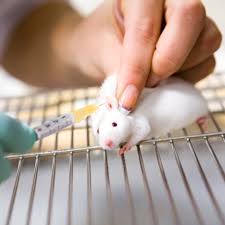
87.5% of animal testing is done on rodents, mice and rats.

245, 786 rabbits are tested on each year for both cosmetic and medical purposes.

Reflection
It is no shocker that
before products can be sold on the market, they must undergo some sort of
testing and approval for the benefit of both the company and the consumer. The
real controversy lies in whether we as humans have the right to test products
out on animals who have no say in the matter.
Those in favor of animal testing for both medical and cosmetic reasons believe that it is essential to try products on other animals before these products can start human trials. Cosmetic animal testing was banned in Britain in 1998. Scientists and doctors claim the reason for animal testing is to ultimately protect the consumer, and only in that instance is treatment of animals in this way allowed. The Guardian posted an article about the realities of animal testing and the laws that protect the workers who work in these laboratories, “The current law permits the deliberate infliction of suffering on animals in laboratories that would normally be illegal in any other circumstances. It's perfectly legal to inflict brain damage on a monkey, genetically engineer a mouse to induce cancer, give electric shocks to a rat and inject or force-feed chemicals to dogs in increasingly high doses until they become sick, suffer from seizures, collapse and finally die." Whenever scientists can they try to use alternative methods of testing their products. There are a lot of computer generated models and cell reconstruction models that are used for a lot of things in bio medical research, but unfortunately animal testing is still necessary for certain areas like blindness and high blood pressure. Tissue cultures can only show so much, and that does not include the effects of high blood pressure. Also, it is very hard to recreate the complexity of the human body and all of its' systems. Nevertheless, the treatment of the animals used in animal testing is not very pleasant. Kittens have their eyes shown shut and mice are given Botox in some UK facilities. Scientists are working on technologies that would eliminate the use of animals to test products, but before they are approved and used by a good population of laboratories it could be years. A specific example of a technology they are working on is essentially a computer chip that would hold the human biological system on it where they could efficiently and accurately test chemicals and medicines on it. They can also grow miniature hearts and other organs, something so advanced and exciting to the medical world. Testing products on animals is not very predictable though as to how these products will actually react on the human body. Testing these products on computer chips and artificially grown organs would allow for higher doses and more experimentation.
Those in favor of animal testing for both medical and cosmetic reasons believe that it is essential to try products on other animals before these products can start human trials. Cosmetic animal testing was banned in Britain in 1998. Scientists and doctors claim the reason for animal testing is to ultimately protect the consumer, and only in that instance is treatment of animals in this way allowed. The Guardian posted an article about the realities of animal testing and the laws that protect the workers who work in these laboratories, “The current law permits the deliberate infliction of suffering on animals in laboratories that would normally be illegal in any other circumstances. It's perfectly legal to inflict brain damage on a monkey, genetically engineer a mouse to induce cancer, give electric shocks to a rat and inject or force-feed chemicals to dogs in increasingly high doses until they become sick, suffer from seizures, collapse and finally die." Whenever scientists can they try to use alternative methods of testing their products. There are a lot of computer generated models and cell reconstruction models that are used for a lot of things in bio medical research, but unfortunately animal testing is still necessary for certain areas like blindness and high blood pressure. Tissue cultures can only show so much, and that does not include the effects of high blood pressure. Also, it is very hard to recreate the complexity of the human body and all of its' systems. Nevertheless, the treatment of the animals used in animal testing is not very pleasant. Kittens have their eyes shown shut and mice are given Botox in some UK facilities. Scientists are working on technologies that would eliminate the use of animals to test products, but before they are approved and used by a good population of laboratories it could be years. A specific example of a technology they are working on is essentially a computer chip that would hold the human biological system on it where they could efficiently and accurately test chemicals and medicines on it. They can also grow miniature hearts and other organs, something so advanced and exciting to the medical world. Testing products on animals is not very predictable though as to how these products will actually react on the human body. Testing these products on computer chips and artificially grown organs would allow for higher doses and more experimentation.
The implications of this topic
are very broad. It deals with the growth of bio- medical technology and the
basic rights that we should either give or not give animals. I think on either
side of this issue, most people are opposed to treating animals this way the
only difference is whether people believe that they would rather have other
animals tested over humans. Maybe like the laws in Britain, the
United States will also adopt some sort of laws against animal testing or
more structured protocol with the increasing technology we have today.

I have never heard about that chip, sounds exciting. I would love to see an end to animal testing.
ReplyDeleteSierra. Good job on your blog freaking. You're right. Globally, there are issues. There really are. In all sierriousness, good job presenting both sides of the argument. Your pictures really help to emphasize how big of an issue animal testing really is.
ReplyDelete